Supply Chain Visibility: Eliminating the Blind Spot Between Warehouse and Production Line
Gain real-time visibility across your supply chain to improve efficiency, reduce disruptions, and accelerate decision-making.
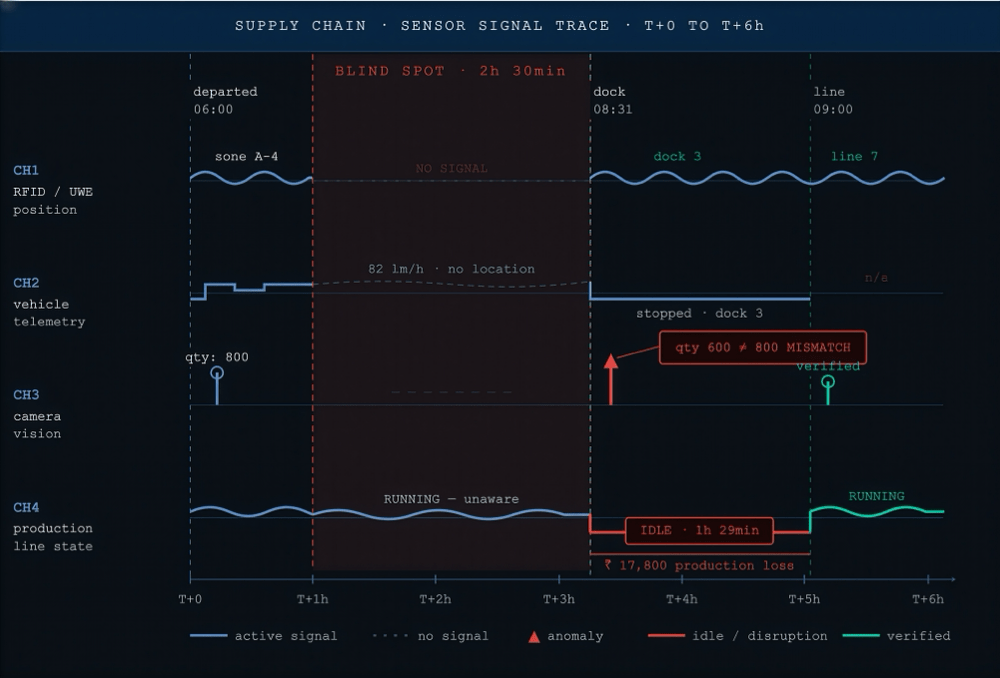
The truck left at 6 AM. The manifest says 800 units of Component A. The production line is scheduled to start at 9 AM. At 8:45, someone calls the warehouse. The component is not on the truck. It never was.
A three-hour blind spot in your supply chain is not a logistics problem. It is a production problem, a cost problem, and a customer problem — all at once.
The Cost of Supply Chain Blind Spots
Every manufacturer understands the theory of just-in-time delivery. Fewer understand the operational reality: the moment your raw material is in transit, it disappears from your visibility. You know when it left. You know when it arrives. Everything in between is a gap.
In that gap, things go wrong. Wrong quantities. Wrong components. Late arrivals. Damaged goods. And by the time the gap is discovered, the production line is already waiting.
The cost cascade
- Line waits for material — idle labour cost accumulates per minute
- Schedule slips — downstream orders delayed, customer SLAs at risk
- Emergency procurement triggered — premium pricing, expedited freight
- Inventory reconciliation required — hours of manual audit work
- Root cause unknown — same problem repeats next week
Real-Time Visibility Across the Supply Chain
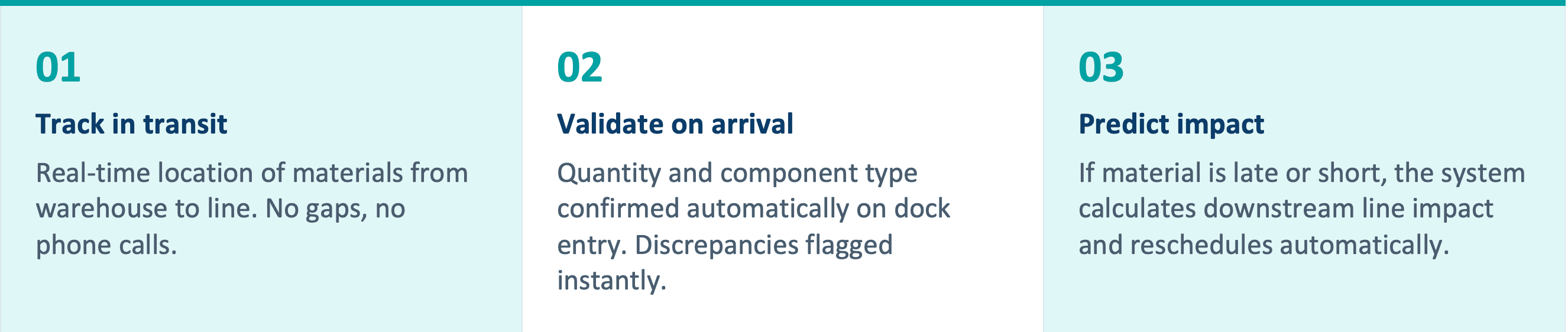
Physical AI connects the supply chain to the factory floor in real time across multiple signal sources simultaneously. RFID and UWB tags on pallets and containers provide real-time location from warehouse to dock. Vehicle telemetry confirms departure times, routes, and estimated arrivals. Camera-based verification at dock entry validates quantities and component types without manual counting. IoT sensors on temperature-sensitive materials flag condition anomalies in transit. With LISA connecting all of these streams into one continuous, real-time view of every pallet, every vehicle, every dock, there are multiple verification points providing a full picture of your supply chain at every moment. The system knows not just that material left the warehouse, but how much, in what condition, and when it will reach each stage of the production process.
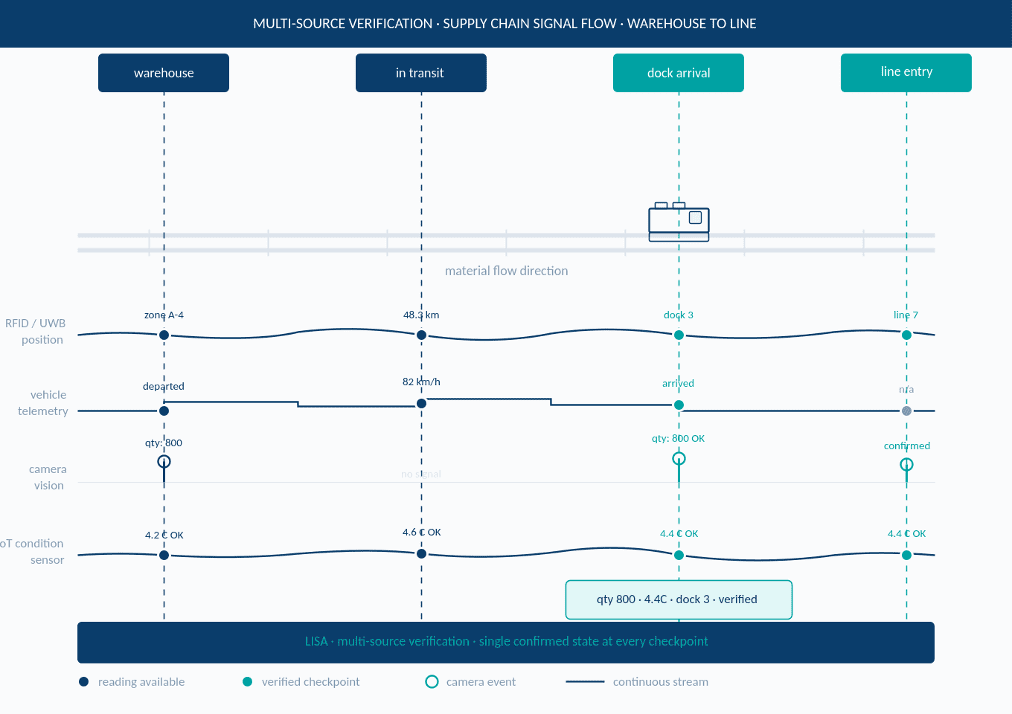
Fig. 2 — Four independent signal sources tracking a single pallet across four checkpoints, converging into one verified supply chain state.
From Reactive Firefighting to Predictive Control
The standard approach to supply chain disruption is reactive: something goes wrong, someone calls someone, a fix is improvised. Physical AI makes the response predictive. The system knows a shortfall is coming before the line feels it — and triggers the response before the disruption lands.
For global manufacturers running multiple production lines across multiple sites, the compounding value of this visibility is significant. Every hour of unplanned idle time has a cost. Every avoided disruption has a return. At scale, the difference between a blind supply chain and a connected one is measured in millions.
Supply chain visibility is not a logistics function. It is a production function, a quality function, and a customer delivery function. When LISA connects every signal between your warehouse and your line, the blind spot disappears. Material arrives confirmed, on time, in the right quantity, with the right condition data. Your production schedule is protected before it is ever threatened.